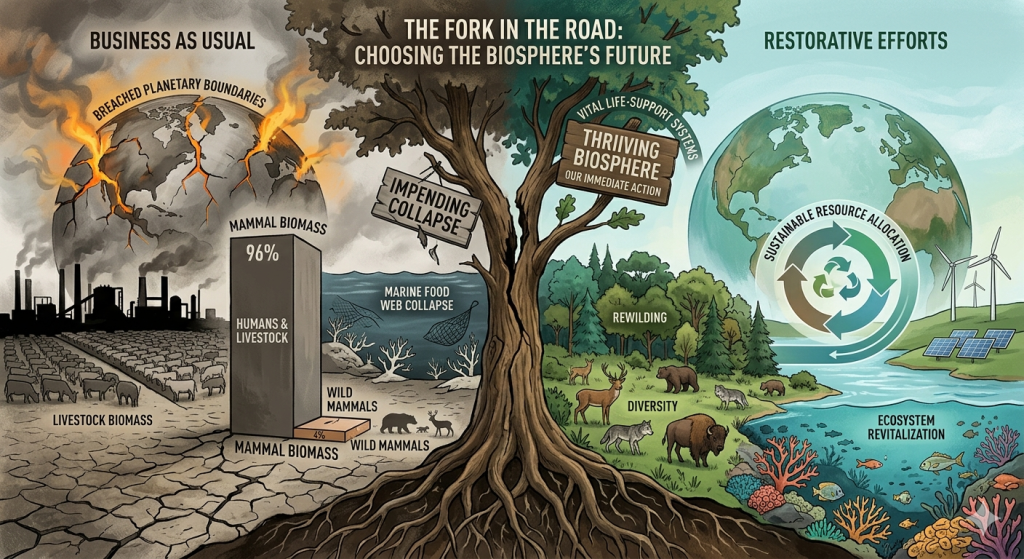
I think everyone is getting fed up with the doom and gloom of climate disruption, destruction of ecosystems and loss of nature everywhere, which is coupled to toxic chemical and plastic pollution, an almost total lack of wastewater treatment and incomplete burning of fossil fuels.
There is no possibility of stopping climate change by carbon mitigation; even if we achieve net zero by 2030, oceanic pH will continue to decline, resulting in the loss of most marine life, the food supply for 3 billion people and the mechanism that actually regulates the climate.
So what is actually being done to stop climate change? There are thousands of small projects around the world on ecosystem restoration, tree planting, restoration of seagrass and mangroves, coral seeding, marine protection zones and hope spots. The work is important and needs to be expanded as much as possible, but it is not enough.
73% of all life on earth has already been lost since 1970 (https://lnkd.in/e59E48Q2), and many other reports are saying the same for insects, marine life and soil biota. Meanwhile, every litre of rainwater falling on the planet contains at least 5 toxic forever chemicals, pharmaceuticals and plastics. How could we have let the state of the planet get so bad?
The problem has almost become too big to comprehend or even to attempt a solution. Instead, it is now being deferred in the hope that AI might come up with some ideas or just plain denial that things are not too bad. The baseline syndrome leads people into a false sense of security, but in accordance with the Allee effect, there will be an exponential crash of the ecosystem possibly over the next 10 to 15 years. Everything will appear normal, then over the course of a year, marine life will experience a trophic cascade collapse. The resulting regime shift takes out all the whales, seals, birds, and fish – a good supply for 3 billion people as well as the mechanism that actually regulates the climate.
It’s time for action on a global scale; the report presented in the link gives some options that can be implemented on a global scale. The cost will be 40 billion to 100 billion dollars. This is almost nothing on a global scale, and the return revenue out of ecosystem services will probably be 20-fold.
View report.
https://lnkd.in/eE5VbR9x